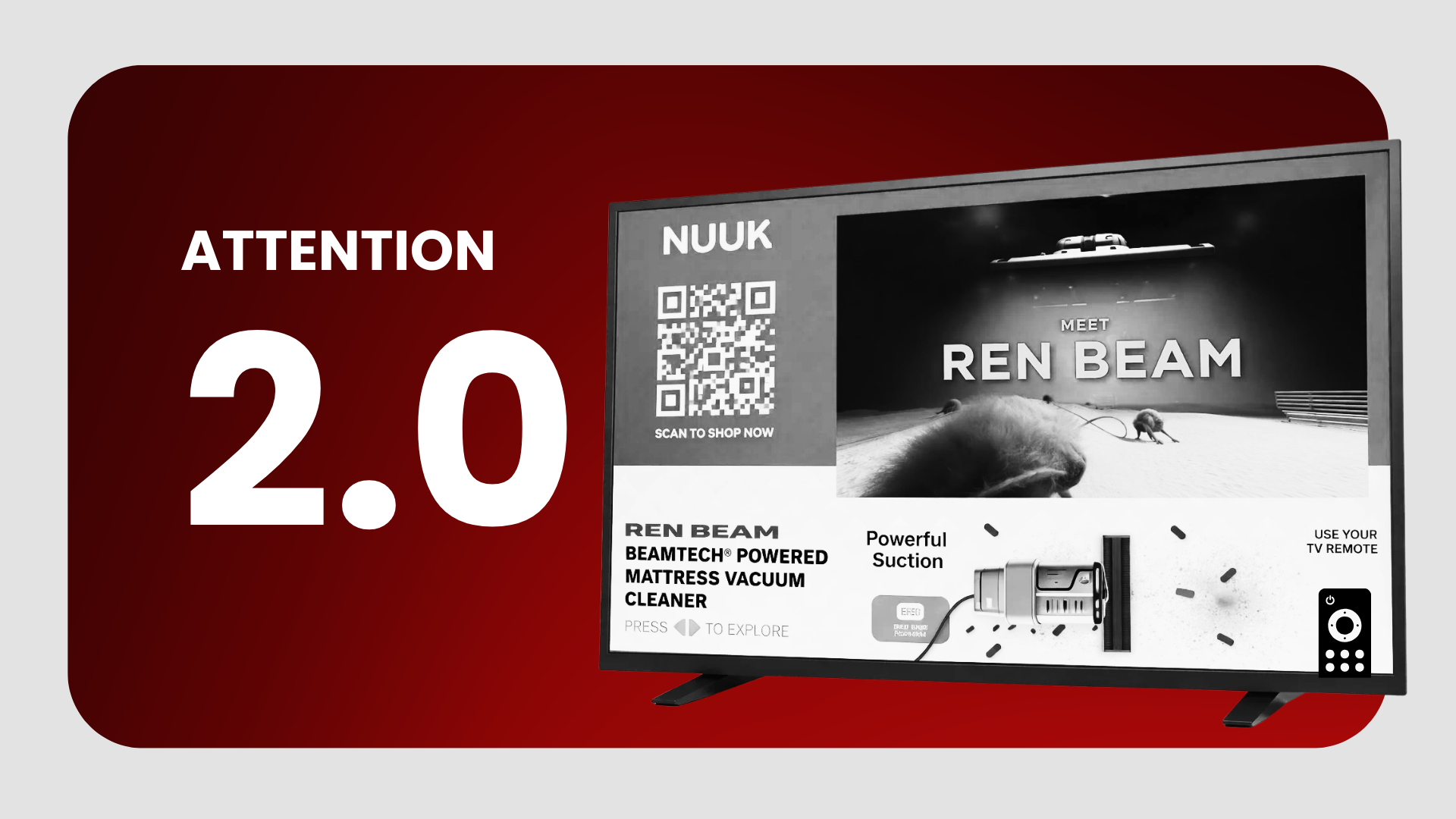









Television commands time. Millions of hours are spent each day in front of the screen in the house, across live sports, long-form entertainment, and endlessly expanding streaming libraries. From a distance, the medium appears stable. Step inside the real world and you will realise, the viewing has evolved tremendously.
Audiences arrive with options in hand. Phones within reach. Choices remain visible even while content plays. Watching now shares space with scrolling, searching, messaging, and comparison. The screen retains its presence, yet attention circulates around it rather than settling in one place.
Advertising operates inside this environment.
Messages appear alongside premium content, delivered at scale, in settings brands still value. What no longer comes bundled with that delivery is guaranteed attention. Exposure meets a viewer who evaluates quickly and commits selectively. While the screen remains central, attention behaves differently. This is the operating condition of Attention 2.0.
We are describing Attention 2.0 as a market where attention is conditional. Viewers register relevance early, disengage without friction, and reserve sustained focus for moments that feel well-timed and well-placed. The shift is behavioural and the implications are commercial.
The shift that ended assumed attention
Television once benefited from structural commitment. Programming schedules shaped behaviour, and advertising travelled alongside that stability. Viewers stayed because there were fewer alternatives and fewer exits.
Connected TV altered that balance. Content became chosen rather than received. Control moved to the viewer. This change has reshaped advertising effectiveness. An impression can register technically while failing cognitively. The delivery may be perfect. The message may still pass through lightly, because attention now begins in a state of evaluation rather than acceptance.
Yes, scale still matters, but presence alone no longer completes the job.
This is where VDO.AI operates, helping brands earn attention rather than assume it. Through context-aware formats, real-time signals, and interactive layers designed for the CTV environment, VDO.AI ensures ads are experienced as part of the moment.
Skipping reveals how decisions are made
Skipping tends to be discussed as a feature. Its real value lies in what it reveals. Viewers are making judgements quickly. Openings are assessed within seconds. Familiar cues trigger dismissal. Messages that feel misaligned with the viewing moment lose priority fast. Sometimes this judgement appears as an active skip. Often it appears as mental absence while the ad continues to run. This dynamic explains why forcing exposure rarely improves outcomes. Restricting exit does not create interest. Attention forms through relevance and timing, not confinement. The creative that performs well under Attention 2.0 earns attention early and sustains it through clarity rather than duration.VDO.AI formats introduce interaction, motion cues, or contextual relevance early, on CTV to interrupt passivity without interrupting experience. They slow the scroll of attention just enough to invite engagement, ensuring the ad does not simply play, but registers.
Multi-screen behaviour reshaped the path to action
Second-screening is no longer incidental. It defines how viewing unfolds. Television often anchors emotion and narrative, phones absorb intent and action. Brand impressions settle in one place while decisions are unfolding in another. This distribution of attention changes how effectiveness should be read.
CTV exposures frequently influence outcomes that appear later and elsewhere. Search behaviour lifts. Site visits arrive warmer. Retargeting performs with less friction. Conversion improves because the audience is already oriented.
The value of CTV has become visibly downstream. The message lands on the it and is followed by the response later when the viewer is ready to move.
Intent turned context into an effectiveness lever
Fragmentation is commonly framed as a proliferation of platforms. For advertisers, the more consequential change is variation in mindset.
A single household can cycle through immersion, casual browsing, background consumption, and active research while the television remains on. This “intent variability” raises the cost of generic messaging. Relevance determines whether an impression advances or stalls. Messages aligned with the viewing moment hold attention longer and leave stronger residue. Messages that feel out of place fade quickly.
Context operates here as an alignment tool. It helps advertising feel situated within the experience rather than layered on top of it. When placement matches mindset, resistance lowers and attention stabilises.
Creative operates under new constraints
High-quality storytelling continues to matter on CTV. What changed is the entry threshold.
Viewers decide quickly whether to stay. The message must orient them early. Brand, purpose, and relevance need to register before attention drifts elsewhere. This requirement does not demand bluntness. It demands legibility.
Creative also ages faster in this environment. Repetition without variation signals familiarity. Fatigue builds. Teams that perform well treat creative as adaptive infrastructure, refreshed and refined to match changing contexts and viewer states.
The Bottom Line
As CTV continues to offer scale, emotional weight, and cultural relevance, its value has not diminished. The automatic relationship between exposure and attention has.
Attention 2.0 reflects a market shaped by choice, layered behaviour, and selective focus. Advertising effectiveness now depends on timing, context, and early clarity. Impressions still matter. Attention has become conditional.
On Connected TV, attention is not awarded for arrival. It is earned in the moment.