








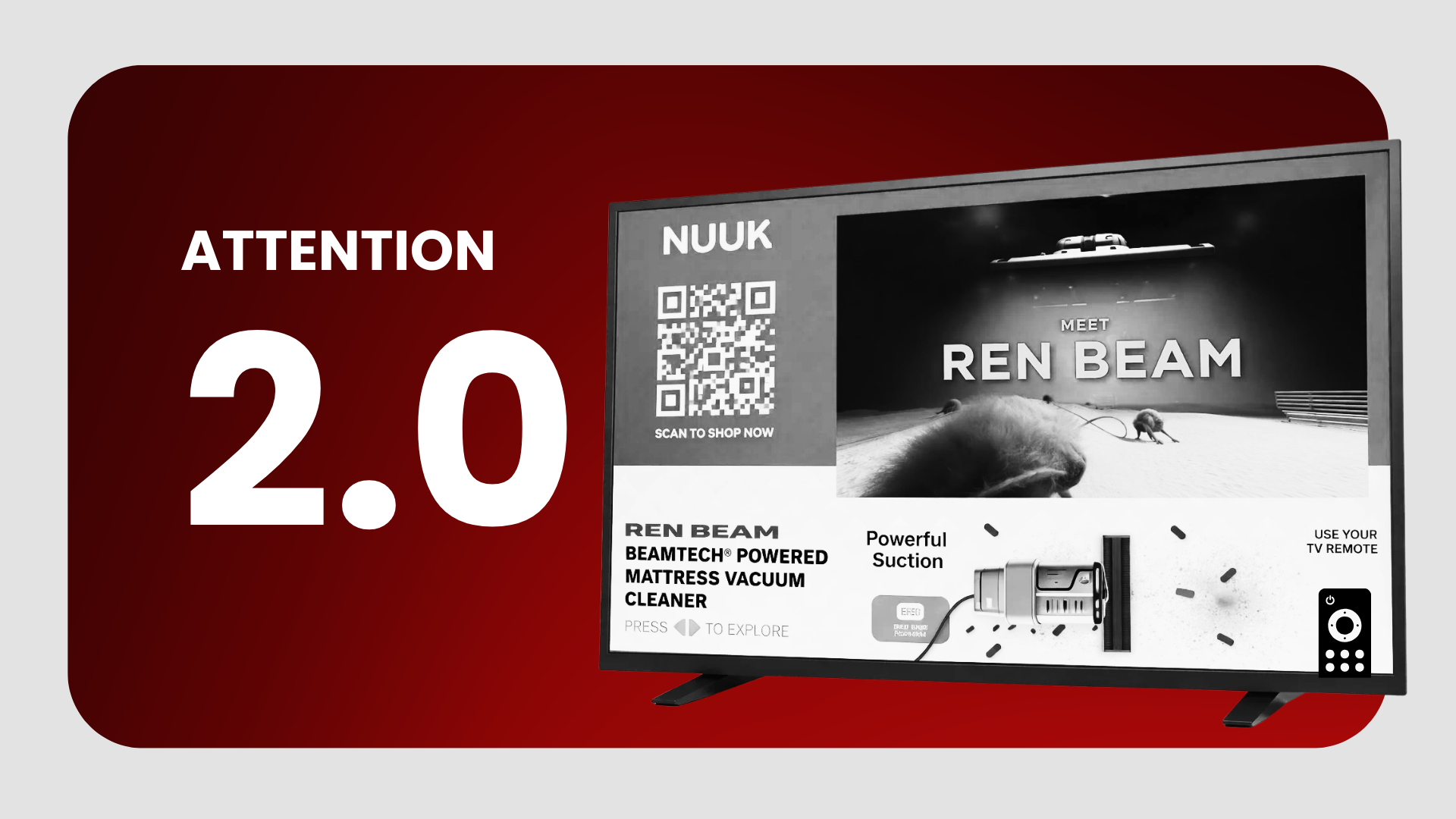
CTV has grown beyond an awareness channel because it can now prove outcomes with far more rigor. Nearly two-thirds of advertisers already using conversion APIs for CTV report improved return on ad spend. That is what performance evolution looks like in practice. Premium storytelling stays the foundation, but measurement and optimization have caught up, so CTV can now be planned for impact you can validate, not only reach you can deliver.
This is Attention 2.0.
The shift that made CTV scalable for outcomes
Performance did not arrive in CTV as a feature. It arrived as a system.
A true performance environment is defined by three things working together. It starts with a clear outcome goal, it depends on a credible way to connect exposure to that goal, and it becomes truly powerful when there is a feedback loop that helps you improve while a campaign is live. CTV now supports that combination far more consistently than it did before, which is why it is increasingly planned beyond awareness.
One clear marker of this shift is how CTV is expected to transact. With roughly 47% of CTV inventory expected to be biddable, the channel is steadily adopting performance style optimization behaviors, which enables faster learning loops, more responsive pacing, and more ability to adjust and improve while the campaign is running. (Source)
The most important shift is simple. Outcomes are no longer treated as a post campaign explanation. They are treated as a planning requirement.
Performance on CTV has a different shape than performance on small screens
One reason CTV performance is working so well right now is that it aligns with real decision behavior. The living room is where people absorb messages with fewer distractions from the ad itself, yet the action often happens later, on another device, in another moment, which is why performance in CTV is best understood as a measurable contribution across a journey and not just immediate response.
That contribution usually shows up in three forms. It can show up as direct action when the offer and the path are clean, and in those cases CTV can generate installs, sign ups, quote starts, purchases, or visits with a performance feel that is easy to quantify. It can also show up as intent acceleration, where the biggest movement is behavioral, including more branded search, higher quality site traffic, deeper engagement and stronger signals that a message landed, which are measurable steps that sit between saw the ad and converted. Finally, it can show up as system efficiency, where CTV improves performance elsewhere because retargeting becomes more efficient, paid social converts with less friction, and search clicks convert at higher rates since the audience is not cold anymore.
This is why CTV does not need to mimic click based channels to behave like performance media. Its performance signature is that it creates high quality exposure that becomes visible in outcomes over time.
The operating layer around CTV matured
Once you look at CTV through the lens of outcomes, the evolution becomes clear. CTV became performance capable because multiple layers matured together, each one reducing uncertainty between exposure and business impact.
Outcome plumbing became cleaner and more durable as measurement shifted toward more structured, privacy-resilient ways to link exposure to conversion events, which improves attribution confidence and makes investment easier to justify. Measurement also became more interoperable, so outcomes are more comparable across partners, screens, and metric types, which makes performance readouts easier to use in real budget conversations.
Optimization became more practical as buying systems enabled quicker iteration, which helps teams learn and improve while campaigns are live without forcing CTV into a lower funnel identity. At the same time, trust became a baseline expectation, since stronger verification and device level integrity improve the credibility of measurement inputs and make outcomes more scalable.
Together, these upgrades form the new CTV performance environment, which is premium reach with proof you can use.
The halo effect: where CTV often delivers its most practical lift
One of the most attractive performance realities of CTV is that the strongest results often show up outside the living room.
A great CTV impression can change what happens next across the funnel, because it can increase intent, strengthen preference, and make downstream channels work harder. Search demand rises, retargeting pools respond faster, paid social converts with less resistance, and conversion rates improve because the first touch was a premium moment.
This is the halo effect in its most practical form. CTV does not just drive outcomes directly. It improves the efficiency of the channels that capture outcomes, and as measurement has matured, this cross channel lift has become easier to observe and easier to defend.
The key is that the evaluation window has to match real behavior. Many decisions influenced by CTV unfold across days, not minutes, and when measurement reflects that timeline, the halo becomes visible and performance becomes a stronger, more consistent story.
Where CTV is headed
As the ecosystem keeps maturing, a few patterns stand out in how CTV is being planned and evaluated when outcomes matter.
Outcome clarity is winning over metric overload because the most scalable strategies define the primary business outcome, select a small set of supporting signals, and use measurement to drive decisions instead of noise. Comparability is becoming the real advantage too, since outcomes that can be interpreted consistently across partners and screens turn reporting into confidence.
Creative is increasingly treated as an outcomes lever. On the biggest screen, the message has to land clearly and the next step has to feel natural, and performance improves when creative bridges premium attention to intent without disrupting the viewing experience.